



Most planning poker tools solve the same basic problem. They let your team vote on estimates. Where they differ is everything around that moment:
- how easy it is to bring in the user story context
- how discussions happen
- whether estimates flow back into your backlog tool
If you’re just trying to pick a tool quickly, you don’t need to read a long comparison. Here’s the short version:
How to choose a planning poker tool (quick answer)
- If you want estimation to create a real team discussion, not just a voting process
→ use Spreo - If you want something fast and simple
→ use PlanningPoker.live - If your team lives entirely inside Jira lists and you want estimation built in → use a Jira plugin like Agile Poker for Jira
- If you need broad integrations (GitHub, GitLab, Slack) and a more structured workflow
→ use Parabol
Why most comparisons miss the point
Most “best planning poker tools” lists focus on features. In reality, the biggest difference is this:
- Some tools treat estimation as a quick voting mechanic
- Others treat it as part of a collaborative conversation
Which one you need depends on how your team works.
Spreo is our product. It’s on this list, and we genuinely think it’s the best tool for distributed or remote teams who want estimation to be a real team conversation — not just a voting process. We’ll show you why, and help where another option might be a better fit for your team.
Planning poker tools come in a variety of formats - as standalone web apps, Jira marketplace plugins, features inside bigger platforms, or integrations inside Slack and Teams. We’ve compared them on equal footing and given our verdict. Here’s what we looked for.
Our criteria for planning poker tools:
- Must integrate with your backlog tool. If it doesn’t write estimates back, your team is better off just holding fingers up to the camera.
- Must be quick so easy estimates can be sped through and the team can spend time on the stories that actually need discussion.
- Must support hidden voting and simultaneous reveal. It’s important to avoid anchoring or bias.
- Must show you the full story, not just the title. If you have to open Jira in another tab to read the acceptance criteria or check linked issues, the flow is broken.
- Form doesn’t matter too much. Web app, Jira plugin, platform feature — we’re comparing them all on equal footing.
- Not a hobby app. You’re working in professional teams. The tool needs to handle data responsibly and be actively maintained.
Quick comparison
| Tool | Best for | Free tier | Backlogs | Price (team of 10) |
|---|---|---|---|---|
| Spreo Agile Platform |
Full ticket context + whiteboard for scope discussions | 30-day trial | Jira, CSV | $60/month |
| Parabol Agile Platform |
Broadest backlog integration (Jira, GitHub, GitLab, Azure DevOps) | 2 teams, 10 meetings | Jira, GitHub, GitLab, Azure DevOps | $80/month |
| Jira plugins Jira plugin |
Estimation without leaving Jira | Free options available | Jira | Free to $349/month |
| PlanningPoker.live Standalone |
Free, no signup, embeds in video calls | 5 credits + 1/month | Jira, Linear | $50/year for monthly sessions |
| PlanningPoker.com Standalone |
The original planning poker tool | 5 players, ads | Jira (paid), CSV | $15–50/facilitator/month |
The tools in detail
1. Spreo
Best for: Full ticket context + whiteboard for scope discussions
Spreo has a dedicated planning poker template with a built-in estimation workflow. Unlike most whiteboard tools, this is not a static canvas but a fully interactive experience with an automated process and Jira integration.
The board has three sections: import your stories at the top of the funnel, estimate in the middle (host-controlled voting with hidden cards and simultaneous reveal), then the estimated stories are automatically stacked up with estimates written to Jira.
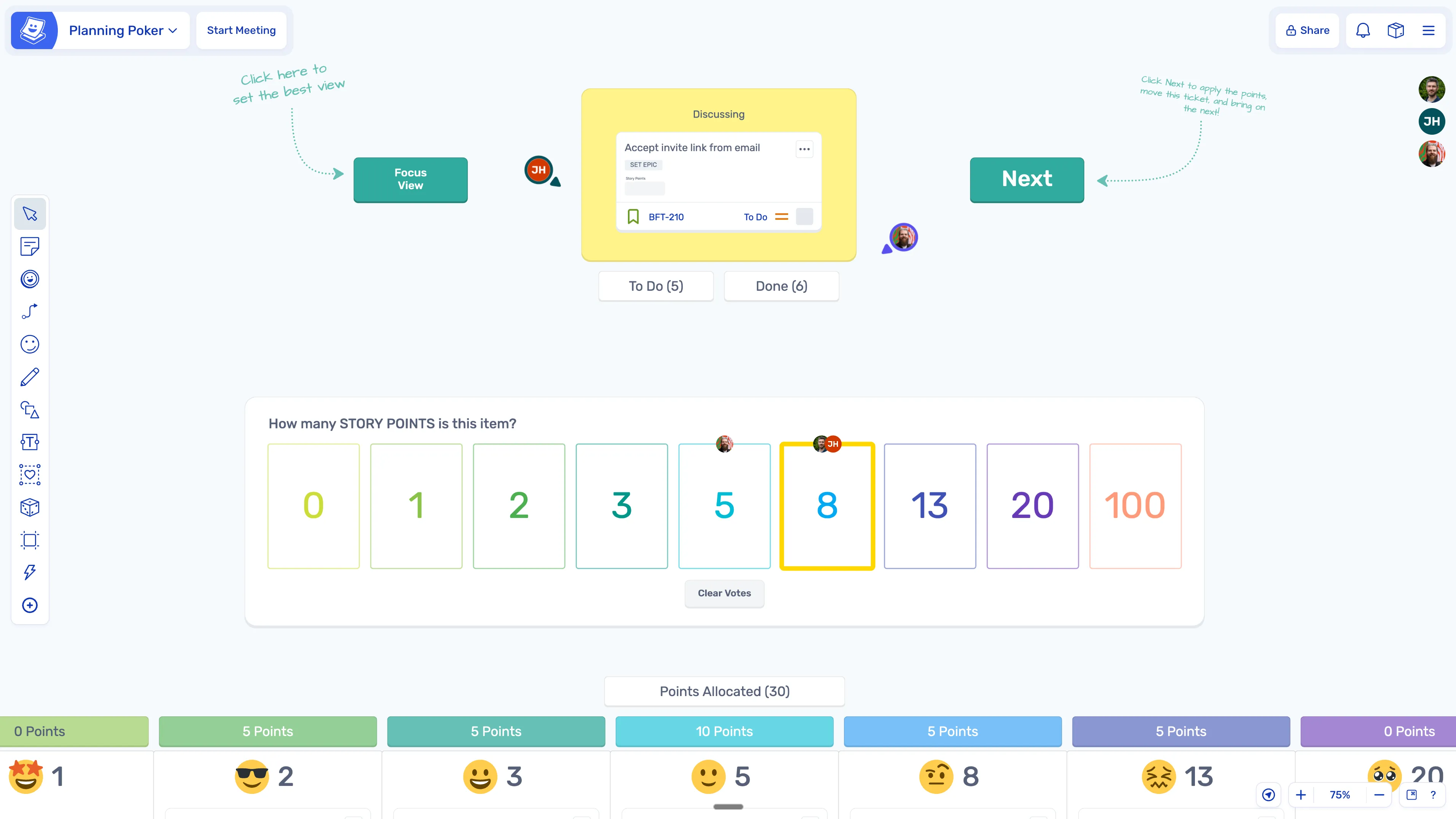
Voting is properly hidden. Values stay hidden until the host reveals. Card decks are customisable — Fibonacci, T-shirt sizes, or your own custom deck. If votes diverge, the host can optionally ask the team for a re-vote. The whole cycle takes seconds for the stories where everyone agrees.
Spreo’s difference to other planning poker tools
Most standalone planning poker tools only show you a title and maybe a description. If someone needs to check or update the detail, they’re opening another tab and screen-sharing.
In Spreo, the full Jira ticket is accessible inside the board — description, acceptance criteria, comments, linked issues. You can update any field without going back to Jira.
And because the estimation happens on a whiteboard, everything else is right there. When votes diverge and someone says “there’s a data migration step nobody’s mentioned,” it can be sketched out, or the team can break the story down on the same board and update their backlog (without having to use Jira!). In every other tool on this list, that conversation either happens verbally and gets lost, or someone says “I’ll update the ticket after.” In Spreo, the context stays visible next to the estimation.
And anyone on the team can make changes — update the ticket, add a note, sketch on the board. It’s not reliant on the meeting host or a dedicated note-taker. That keeps people active in the session instead of zoning out.
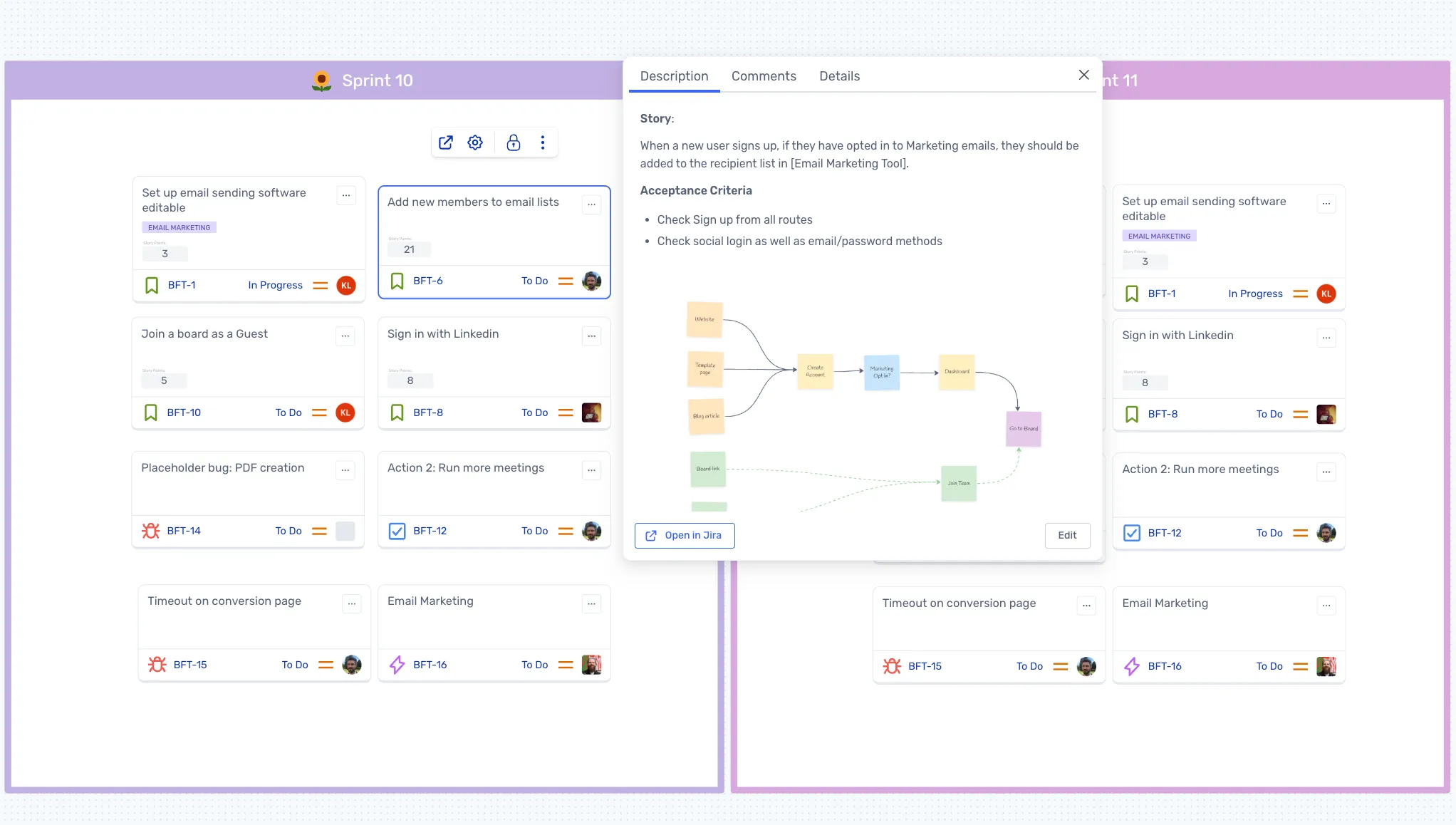
Spreo’s estimation process works without Jira integration too. Import stories from CSV, copy/paste, or add manually. Export the results to CSV or HTML table.
| Pricing | Planning poker with Jira sync available on the Business plan at $6/team member/month. 30-day free trial, no credit card required. |
| Backlog | Jira. CSV. |
| Where it falls short | No free plan. Jira sync requires the Business plan. If you only need estimation and nothing else, a dedicated tool is lighter. |
“I run retrospectives and interactive training sessions but also use Spreo to analyse root causes, structure meetings with Lean Coffee, use sprint planning poker for estimation, or just for brainstorming.” — Veronica Onu, Agile Coach, Minsait
Try Spreo’s planning poker template free for 30 days, no credit card needed.
2. Parabol
Best for: Broadest backlog integration (Jira, GitHub, GitLab, Azure DevOps)
Parabol is open-source (AGPL-licensed), covering retrospectives, sprint poker, and standups. The reason it’s on this list: it integrates natively with Jira, GitHub, GitLab, and Azure DevOps. Broadest backlog integration set of anything here. SOC2 Type II compliant, and you can self-host if your organisation requires it.
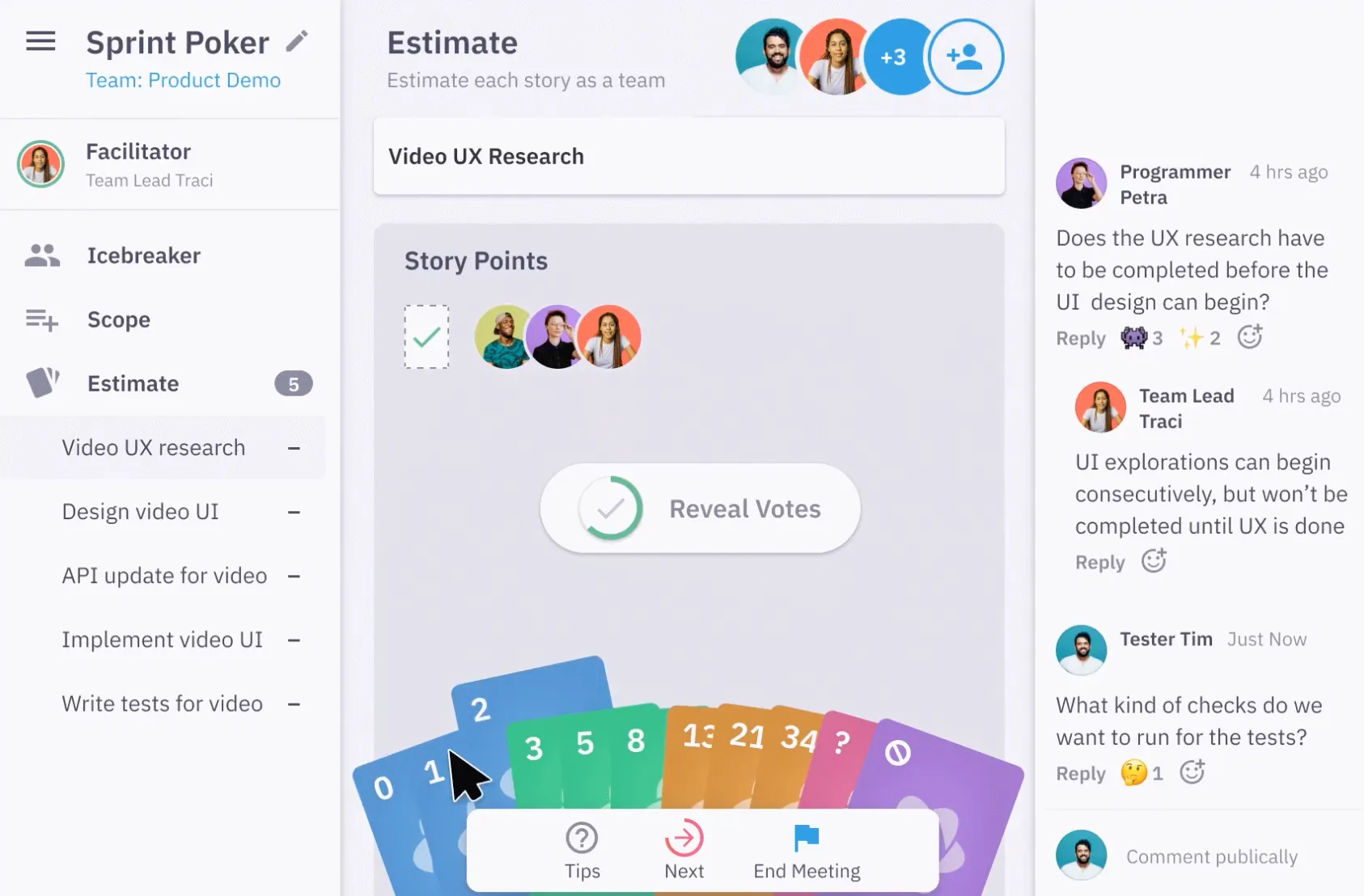
The Sprint Poker flow is structured: pull stories, vote, reveal, discuss. No spatial canvas. It’s a list-and-cards UI rather than a visual board, but it gets the job done. Estimates write back to whichever tracker you pulled the stories from.
If Parabol is on your shortlist, we’ve put the two side by side in our Spreo vs Parabol comparison.
| Pricing | Free for up to 2 teams (unlimited members, 10 meetings/month). Paid plans start at $8/user/month. |
| Backlog | Jira, GitHub, GitLab, Azure DevOps (all with writeback). Broadest integration set. |
| Where it falls short | Everyone needs an account to participate. You can’t sketch out an ambiguous story mid-estimation or add context visually. At $8/user/month, a team of 10 is $80/month. |
3. Jira marketplace plugins
Best for: Estimation without leaving Jira
If you want planning poker without leaving Jira, there are several marketplace plugins. All are Cloud Fortified, all write estimates back to your Jira fields natively. The catch: most are priced on the total number of users on your Jira instance, not the number of people doing estimation.
The main options:
Planning Poker Agility (Agile Pulse) — The free option. 2,831 installs, 3.7/4 from 74 reviews. Real-time voting with automatic reveal, Fibonacci and custom values. No feature gating, no user limits. Jira Cloud only. The same team also makes SprintPoker, a newer paid version with AI estimation suggestions, reference matching against past stories, and a quick-estimate mode directly from the Jira issue panel. SprintPoker is $0.84/user/month for 11-100 Jira users (151 installs so far).
Planning Poker® (Appfire) — Most installs on the marketplace (4,228, 3.7/4 from 133 reviews). Sessions run inside Jira with a reference issues panel for comparing against similarly-sized stories from past sprints. Supports 30+ simultaneous players. Free up to 10 Jira users, then $3.49/user/month based on instance size. 100 Jira users = $349/month. Jira Cloud, Server, and Data Center.
Agile Poker for Jira (Appfire) — Appfire’s other plugin (2,063 installs, 3.7/4 from 109 reviews). Four estimation methods: planning poker, Magic Estimation (relative sizing), Wideband Delphi (async), and prioritisation poker. Appfire AI suggests effort based on historical data. Same pricing as Planning Poker®. More capable but more complex.
A note on names: Appfire licences the “Planning Poker®” trademark from Mountain Goat Software (Mike Cohn). PlanningPoker.com (#5 below) is Mountain Goat Software’s own product. They are separate companies.
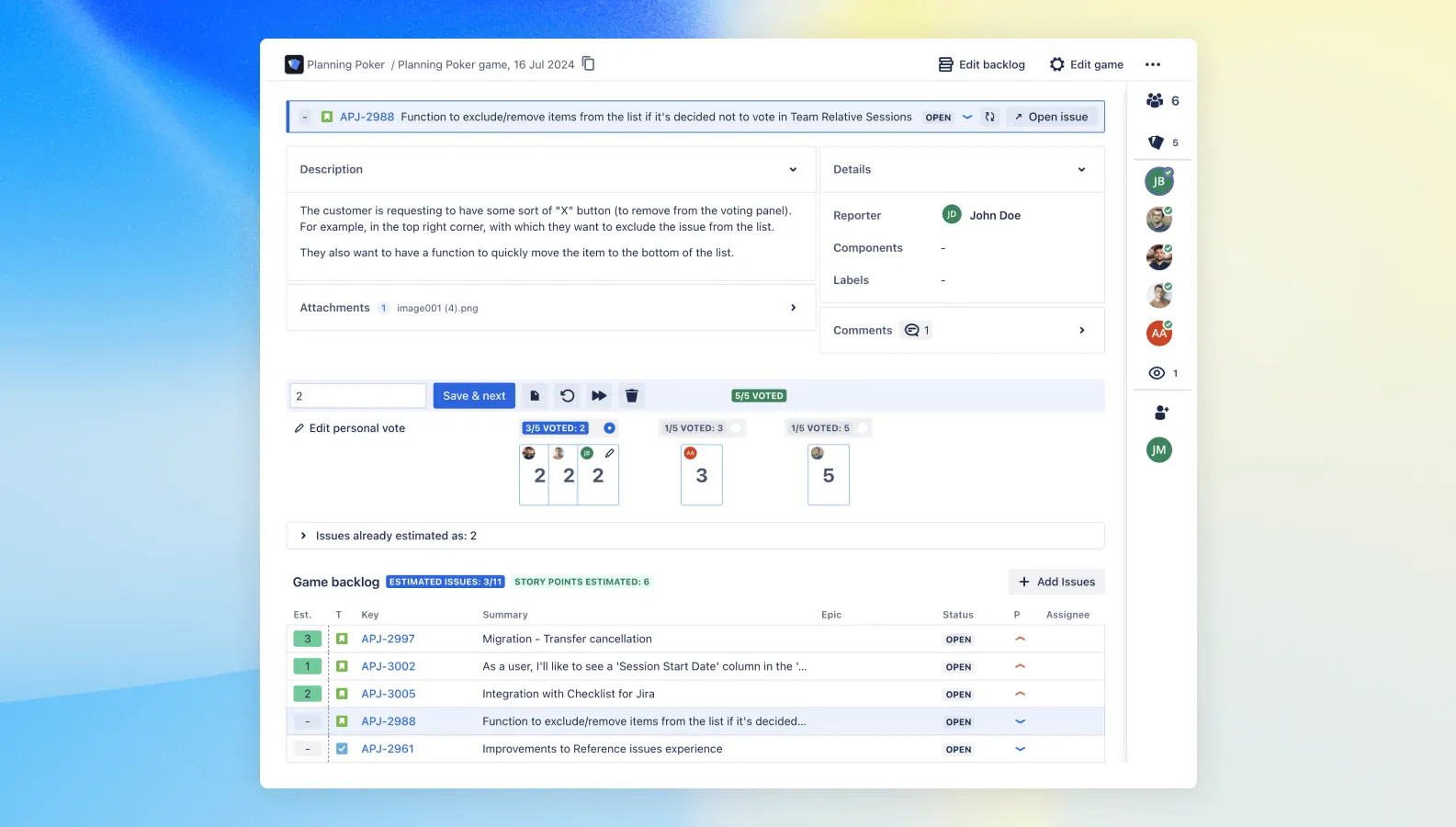
| Pricing | Planning Poker Agility: free. SprintPoker: $0.84/user/month. Appfire plugins: $3.49/user/month. All based on Jira instance size, not estimators. |
| Backlog | Jira (native writeback to story points and custom fields). No other backlogs. |
| Where they fall short | Jira only. Instance-based pricing means you pay for your whole Jira, not your estimation team. No GitHub, Linear, or Azure DevOps. |
Note - Spreo as an alternative Jira issue editor
Spreo allows you to edit Jira issues directly from your boards, so there’s not a huge amount of difference using a Jira plugin compared to a Spreo board. Here’s a demo:
4. PlanningPoker.live
Best for: Free, no signup, embeds in video calls
PlanningPoker.live is open source, free to join, and more capable than you’d expect. No accounts needed to vote. The host creates a room, shares a link, and the team starts estimating. It integrates with Jira and Linear, both with automatic writeback, both free. It also embeds directly inside Zoom, Microsoft Teams, Google Meet, and Webex, so there’s no switching tabs during a call.
Import Jira issues by sprint, project, or search. Vote with Fibonacci, T-shirt sizes, or custom card decks. After the reveal, one click pushes the estimate back to the Jira issue. The Linear integration works the same way.
The pricing model is unusual: Creating rooms costs one credit. You start with five free credits plus one free credit per month. Need more? One-time purchases: $9 for 7 credits, $17 for 15, $50 for 50. No subscription.
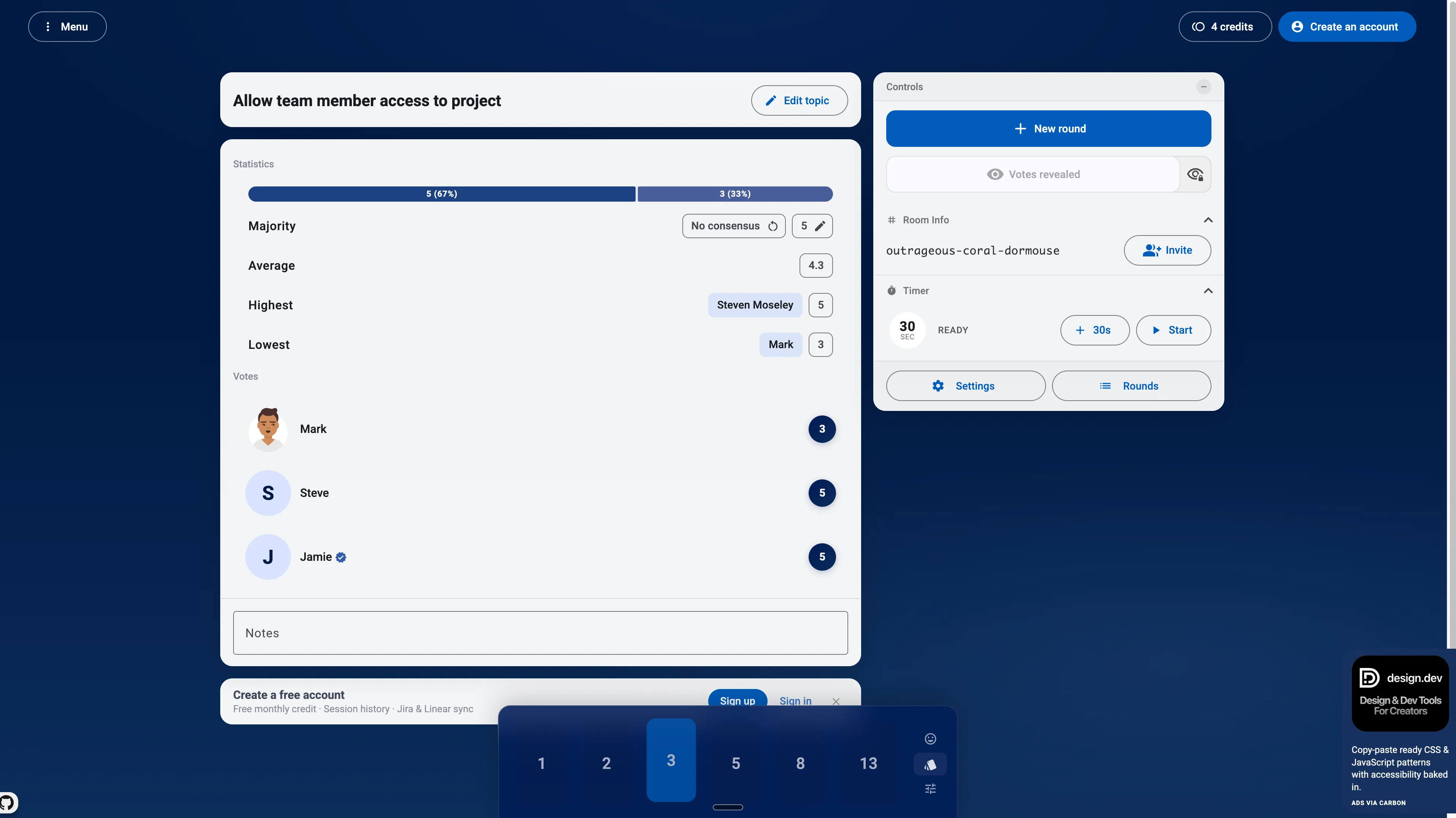
| Pricing | Free to join rooms. Creating rooms costs 1 credit each. 5 free credits to start + 1 free per month. Top-up bundles: $9 (7 credits), $17 (15 credits), $50 (50 credits). All one-time, no subscription. For weekly sessions, the $50 bundle plus free monthly credits covers a full year. |
| Backlog | Jira (free, with writeback), Linear (free, with writeback). |
| Where it falls short | No GitHub, GitLab, or Azure DevOps integration. Ad-supported on the free tier. Two-person project, not a company with a support team. |
5. PlanningPoker.com (Mountain Goat Software)
Best for: The original planning poker tool
The original. PlanningPoker.com is owned by Mountain Goat Software (Mike Cohn, who popularised planning poker in the first place). They hold the “Planning Poker®” trademark. The tool was rebuilt by digital agency 352 Inc.
Import stories from Jira, or via CSV/XML from TFS, Rally, and VersionOne. Players join free without creating an account; only the game organiser needs a paid plan. Claims GE, Cisco, Adobe, Amazon, IBM, Coca-Cola, and Wells Fargo as users.
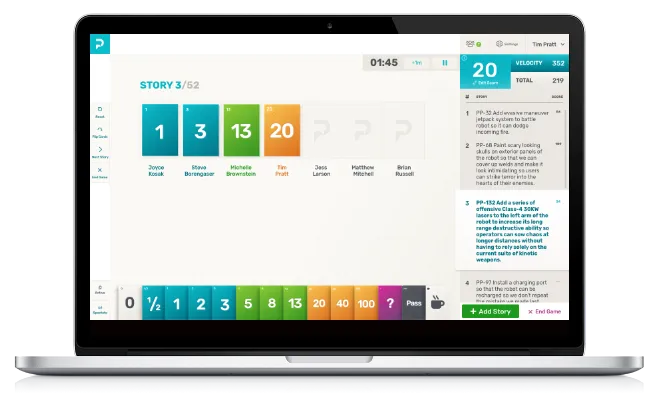
| Pricing | Free: 5 players, ads, 4 scales. Standard: $14.95/month (10 players). Pro: $49.95/month (50 players). Per game organiser; players join free. 14-day Pro trial on signup. |
| Backlog | Jira (import and export on paid plans). CSV/XML import from TFS, Rally, VersionOne. |
| Where it falls short | Expensive: $15-50/month per facilitator. Knowledge base hasn’t been updated in 6 years. Free tier limited to 5 players with ads. No GitHub, Linear, or Azure DevOps. |
Also worth knowing about
These tools have backlog integration but didn’t make the main list due to product experience, limited adoption, restrictive free tiers, or split products:
Planning Poker Online (planningpokeronline.com) — ISO 27001 certified. Web app supports Linear; Jira integration is a separate marketplace plugin (653 installs). Free tier: 9 votes, 5 issues per game. Premium: $30/facilitator/month. Web app and Jira plugin are separate products with separate pricing.
Scrumpy — Free Jira plugin with Azure DevOps, GitHub, and GitLab import. Certainty tracking feature. 766 installs, zero reviews. Side project of a Bulgarian edge-computing company.
Kollabe — Clean standalone tool with Jira and Azure DevOps writeback. Free for 10 users, 4 sessions/month. Paid: $12/space/month flat rate.
TeamRetro — Free, no signup. Multiple card decks. Primarily a retrospective tool.
Tools without backlog integration
These let you flip cards and agree on a number, but someone updates Jira by hand afterwards. For a one-off session they’re fine. For regular refinement, see above.
PlanITpoker — Free for up to 7 participants (ad-supported). CSV/XML import. Premium ($20/month flat) adds Jira import, but it’s one-way only: estimates don’t write back. Same parent company as EasyRetro. Site copyright ends at 2023.
StoryPlan — Planning poker inside Slack. 3,000+ companies. Free for 100 stories/month, $3/user/month premium. Can convert Jira links into stories, but estimates don’t sync back. CSV export only.
Tips for better distributed planning poker sessions
Planning poker was designed for people in a room with physical cards. Making it work across screens and time zones takes a few adjustments.
Refine before you estimate
If the team is asking “what does this story actually mean?” during planning poker, the story isn’t ready. Backlog refinement should happen before estimation, not during it. This matters more for distributed teams where clarifying questions are harder to ask on the fly.
Hidden voting is non-negotiable
In a room, you can at least flip cards simultaneously. On a video call, if the tech lead says “this is a 3” before anyone else votes, you’ll get a room full of 3s. Every tool on this list supports simultaneous reveal. Use it. There’s no reason not to when you’re remote.
Set a time limit per story
Two minutes of discussion plus one round of voting is enough for most stories. If you can’t converge in two rounds, the story probably needs splitting. This is more important in distributed sessions, where silence on a call feels longer than silence in a room and discussions can drift without a timebox.
Don’t chase false precision
The difference between a 5 and an 8 matters less than whether the team has a shared understanding of the work. If estimates are close, pick one and move on. Speed through the easy ones so you have time for the stories that actually need discussion.
Review your estimates over time
After a few sprints, look back at how your estimates compared to actual effort. Most teams find they’re consistently off in predictable ways, and adjusting for that pattern improves estimation more than any tool change.
Start estimating with your team
Pick the planning poker template, connect Jira, and run your first estimation session in minutes. Story points sync back automatically.
Try Spreo free for 30 days — no credit card required. Boards stay in read-only after the trial.
Features and pricing checked against official sources, April 2026.
Planning Poker is a registered trademark of Mountain Goat Software, LLC. This article uses the term editorially to describe the estimation technique. Spreo is not affiliated with or endorsed by Mountain Goat Software.